Verbal Routines That Encourage First Words

Updated: Aug 3
By Tamara Gonzalez-Scheulov, M.S., CCC-SLP

Did you know that using the same simple phrases during everyday routines, like snack time, getting dressed, or play, can help your child learn to communicate more confidently?
This strategy is called script therapy. It works by giving your child repeated exposure to key words and phrases that are meaningful, predictable, and tied to real-life moments - even the busy, on-the-go ones.
Why Use Verbal Routines?
Verbal routines give children a reliable framework for communicating in familiar situations. When the language is predictable and practiced, children are more likely to participate and build toward spontaneous communication.
This repetition helps children learn vocabulary through a process called word mapping. While some children learn new words after only a few exposures, children with language delays often benefit from hearing words and phrases many times before they begin to understand and use them independently.
Here are six simple ways to use verbal routines throughout your day to support your child's communication.
Tip 1: Pick predictable family routines
Think about parts of the day that happen over and over again, like washing hands, getting into the car, eating lunch, bedtime, or going for a walk in the neighborhood. These are perfect moments for using scripted phrases because your child already knows what to expect and repetition helps language stick.
Examples:
Morning Routine: Waking up, getting dressed, brushing teeth, combing hair.
Mealtime: Making breakfast/lunch/dinner, setting the table, sitting down to eat, requesting food, cleaning up
Handwashing & Bath Time: Turning on water, using soap/bubbles, rinsing, drying off
Getting Ready to Go Out: Putting on shoes, zipping sweater or jacket, grabbing bag
Playtime: Setting up toys (opening/closing, finding toy, turning on/off, etc.,), taking turns, cleaning up together
Story-time: Choosing a book, urning pages, saying familiar lines
Bedtime: Pajamas on, brushing teeth, reading a bedtime story , hugs, kisses, lights off
You can turn these daily routines into language-rich moments by using the same words, songs, or phrases each time.
Tip 2: Choose simple, repeatable phrases
Using short, familiar phrases during these routines helps your child understand what’s happening and encourages them to join in.
For example, if you always say, “Big hug!” as you wrap your arms around your child, they may begin to associate those words with the comforting feeling of being held. Over time, your child might lean in, smile, or even say “hug” when they hear the phrase, showing they understand and want to participate.
Remember to keep your tone warm, your words simple, and your pace slow enough for your child to process or potentially take a turn.
Tip 3: Pair with gestures or visual cues
Adding gestures, signs, or pictures to your words gives your child extra support for understanding and communicating.
Children with language delays often benefit from seeing what you mean as well as hearing it. These visual cues can help reduce frustration, support comprehension, and give your child more ways to express themselves.
Pointing: Point to the toothbrush when you say, “Time to brush your teeth,” or point to the door while saying, “Let’s go outside!”
Baby signs or simple ASL: Target baby signs each week and pair with words.
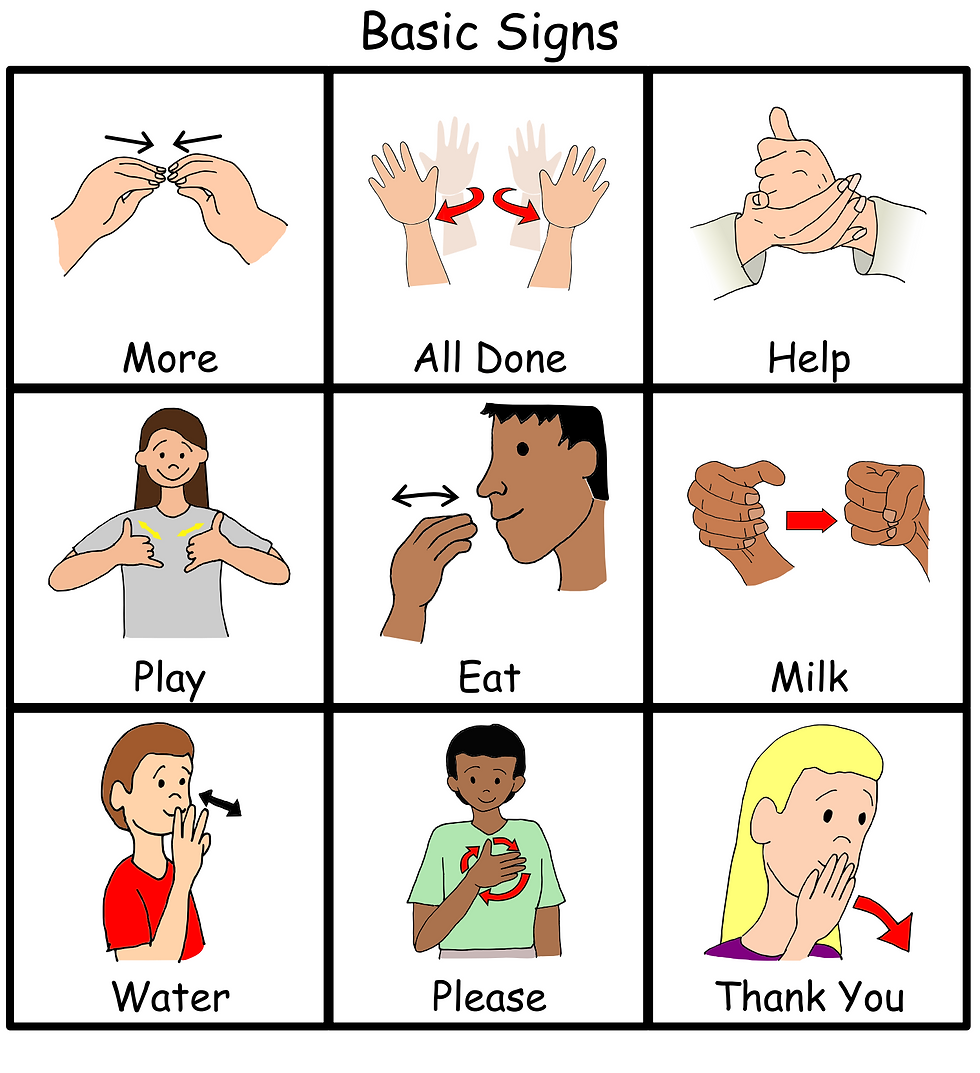
Pictures or visual schedules: A visual schedule shows the steps in a routine using pictures or symbols, helping your child anticipate what’s coming next.

Low-tech AAC (Augmentative and Alternative Communication): A low tech AAC or communication board can support your child’s understanding and expression.

Tip 4: Use Simple Songs
Singing adds rhythm, repetition, and fun, making it easier for your child to understand and join in. You don’t need perfect pitch - just slow it down, emphasize key words, and repeat the same songs during familiar routines. Over time, your child may start to hum along, fill in words, or use gestures.
Tip 5: Use an expectant pause to invite participation
For example, during cleanup you might say, “Clean up, clean up everybody everywhere…”, then pause and look at your child before continuing. Over time, your child may start to fill in the missing word.
Tip 6: Celebrate any response
Whether your child repeats a word, uses a gesture, or simply looks at the object, they’re communicating, and that’s worth celebrating!
Every small response is a sign that your child is making connections and learning how communication works.
About the Author

Tamara is the owner of Little Chatterbox, LLC and an SLP with experience across early Intervention, private practice, and school-based settings. She specializes in supporting infants, toddlers, preschoolers, and early elementary-aged children with speech, language, social communication, and school readiness skills. Her approach combines evidence-based practice with play, connection, and family-centered coaching.
References
American Speech-Language-Hearing Association. (2024). Augmentative and alternative communication. https://www.asha.org/public/speech/disorders/AAC/
Bloom, P. (2002). How children learn the meanings of words. MIT Press.
Carey, S. (1978). The child as word learner. In M. Halle, J. Bresnan, & G. A. Miller (Eds.), Linguistic theory and psychological reality (pp. 264–293). MIT Press.
Charlop-Christy, M. H., & Carpenter, M. (2000). Modified incidental teaching sessions: A procedure for teaching complex language to children with autism. Journal of Positive Behavior Interventions, 2(2), 77–91. https://doi.org/10.1177/1098300700002002
Gray, S. (2004). Word learning by preschoolers with specific language impairment: What predicts success? Journal of Speech, Language, and Hearing Research, 47(5), 1117–1132. https://doi.org/10.1044/1092-4388(2004/083)
Nelson, N. W. (1989). Techniques for naturalistic intervention. In M. Rice & R. L. Schiefelbusch (Eds.), The teachability of language (pp. 165–195). Paul H. Brookes.
Romski, M., & Sevcik, R. A. (2005). Augmentative communication and early intervention: Myths and realities. Infants & Young Children, 18(3), 174–185. https://doi.org/10.1097/00001163-200507000-00002
Roskos, K., Burstein, K., & Sullivan, S. (2013). A small-scale study of the effects of supplemental vocabulary instruction on preschoolers with vocabulary delays. Creative Education, 4, 15–22. https://doi.org/10.4236/ce.2013.47A1003