
Complex Communication Needs

Updated: Aug 3
A Practical Guide for Early Childhood Educators
By Tamara Gonzalez-Scheulov, M.S., CCC-SLP

Preschool classrooms bring together children with a wide range of strengths, developmental profiles, and communication styles. For some toddlers and preschoolers, spoken language alone is not enough to support participation in play, routines, and social interactions.
What Are Complex Communication Needs?
Children with complex communication needs (CCN) have difficulty relying on spoken language alone to communicate and may have challenges understanding language.
Children with CCN require multiple ways to communicate in order to participate fully in early childhood settings. With early support and consistent communication strategies, these children can meaningfully participate in play, routines, and learning in early childhood settings.
Understanding Minimally Verbal Communication
Some toddlers and preschoolers with complex communication needs are described as minimally verbal or non-verbal. This term is commonly used for children who use very few meaningful spoken words, typically fewer than 10–20, or whose speech is not yet an effective way to communicate beyond the age when spoken language is usually expected to emerge.
In early childhood classrooms, these children typically want to participate in play, routines, and social interaction, but may need additional communication supports, such as Augmentative and Alternative Communication (AAC), to help them share ideas, express needs, and engage meaningfully with others.
Augmentative and Alternative Communication (AAC)

Augmentative and Alternative Communication (AAC) includes all the ways a child can communicate without using spoken language. AAC supports communication by giving children more ways to understand language and express themselves.
AAC can include:
gestures and body movements
signs or sign language
pictures or communication boards
visual supports
speech-generating devices or apps
or a combination of these
For toddlers and preschoolers with complex communication needs, AAC helps bridge the gap between what a child understands and what they are able to express using speech alone.
Multimodal Communication in Early Childhood
Research shows that children with complex communication needs make the most progress when a multimodal approach is used. Combining speech with play-based interactions, modeling, visual supports, and AAC helps children access language during everyday routines.
A multimodal approach reduces frustration, increases opportunities for communication, and supports meaningful participation, laying the foundation for language, learning, and social connection in early childhood environments.
SLP Tips
Supporting Children with CCN Through Inclusive Practices
Use a Total Communication Approach
Total Communication means honoring all the ways children communicate, not just spoken words.
Children with complex communication needs may communicate using gestures, pointing, facial expressions, vocalizations, signs, pictures, AAC systems, body movements or behavior.
This approach reduces frustration, builds trust, increases engagement and teaches children that communication works.
Instead of focusing on getting a specific response (e.g., “say XX” “use your words”), adults interpret the child's message, acknowledge and respond.
What this looks like in the classroom:
A child points to a toy → “you want the car.”
A child pushes materials away → “all done.”
A child looks at the door → “want to go outside.”

Model AAC All Day, Every Day

Children learn language by seeing and hearing it used consistently.
That means:
adults model AAC while they talk
AAC systems are available throughout the day
children are encouraged, but not required, to use AAC
spoken language, visuals, signs, and symbols are used together
Research reminds us that children who use AAC need far more exposure than they typically receive.
What AAC modeling can look like:
Pointing to symbols while saying “more snack”
Using a core board during circle time (go, stop, turn)
Modeling on a device during play (help, like, my turn)
Using visuals during transitions (first clean up, then outside)
By 18 months babies have heard 4.380 hours of spoken language. Yet we don’t expect them to be fluent speakers.
If children using AAC only see AAC twice a week for 30 minutes, it will take 84 years for them to have the same exposure as an 18-month-old.
Jane Korsten
Provide Access to a Robust AAC Core Board
Early childhood educators often worry that core AAC boards include too many words and may overwhelm young children. As a result, some classrooms limit AAC systems to only a few symbols.
Research shows that children learn language by being exposed to rich, meaningful language. Providing access to a robust core board does not mean children are expected to use every word right away. Instead, it allows adults to model a wide range of language across daily routines.
A robust core board gives children room to grow, even if they begin by using only a few words.
Access Matters More Than “Too Many Words”
Rather than focusing on how many words a child should start with, it is more helpful to consider what the child can see, reach, and physically access. Many children can manage more options than we expect, especially when words stay in consistent locations and adults model their use.
Consistent access to a robust AAC system also supports motor planning. When symbols remain in the same place, communication becomes faster, easier, and more automatic over time.
Keep AAC Core Boards Accessible Throughout the Classroom

Core Boards Throughout the Classroom 
Core board at the playground 
Activity Based Core Board
Laminate your core board and place copies in different areas of the classroom.
When core vocabulary is available across routines, such as play areas, circle time, outdoor recess area, snack tables, and transition spaces, children have more opportunities to see language modeled and to participate in meaningful interactions throughout the day.
Create Predictable Classroom Routines
Predictable routines support understanding, participation, independence, and communication. Each routine should have a clear beginning, middle, and end.
In early childhood classrooms, routines are most effective when they are taught, modeled, and practiced, not simply expected.
Build Routines Within Routines
Embedding small, consistent steps within everyday activities, such as arrival, transitions, clean-up, circle time, or snack, gives each routine a clear beginning, middle, and end.
When children know what to expect, adults can pause, wait, and allow children to initiate communication or actively engage.
Use Visual Supports to Reduce Language Load
Visuals help young children understand expectations, process information, stay regulated, and participate more independently. It also reduces the amount of spoken language children need to hold in mind and supports comprehension throughout the day.
There are many ways to use visual supports in early childhood classrooms, and the examples below highlight some commonly used and effective options.
First–Then Boards
Help children understand what is happening now and what comes next.

Visual schedules
Support understanding of the daily routine and reduce uncertainty during transitions.

Visual steps within a routine:
Show each step of an activity or routine, such as washing hands, cleaning up, getting ready for snack, or lining up. These visuals break routines into manageable parts and support independence.

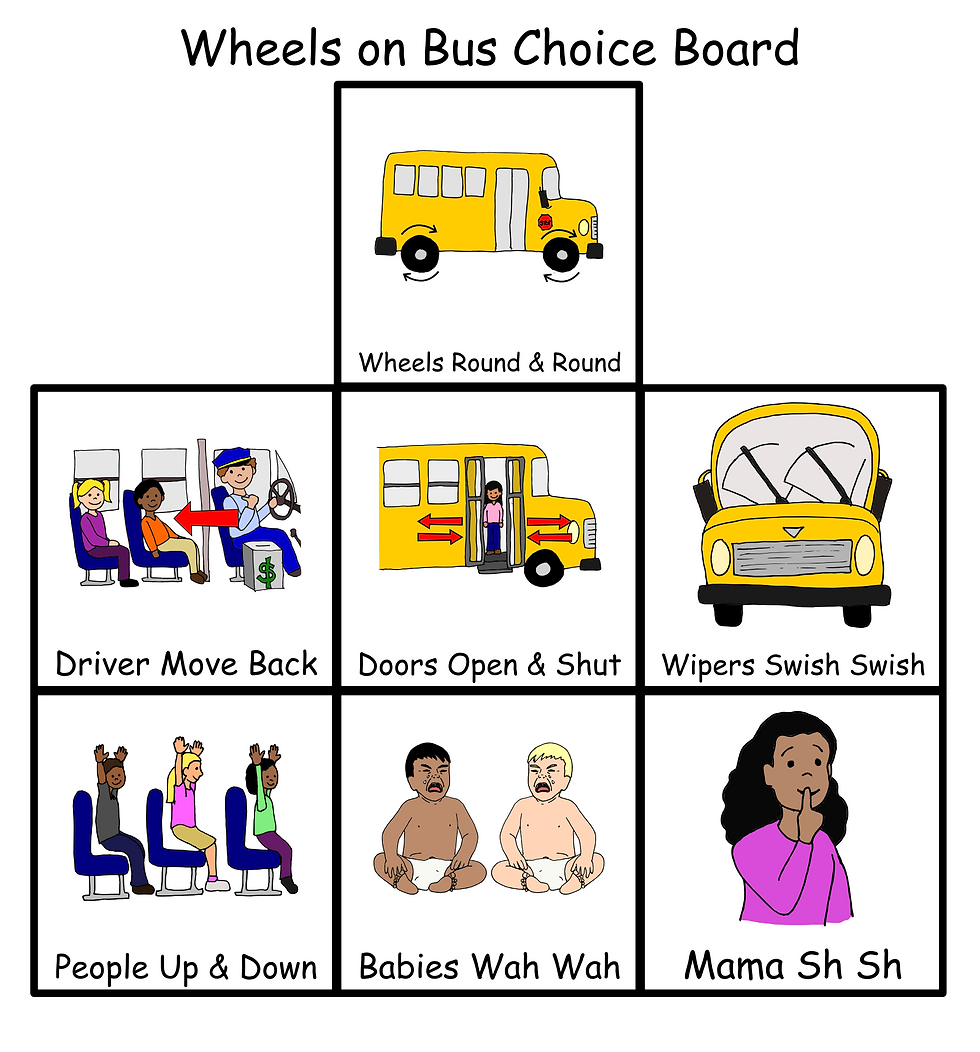
Choice boards:
Give children a clear way to make choices and participate in decision-making.
Core vocabulary boards
Provide access to high-frequency words that can be used across many activities and routines.

Step-by-step visuals for activities & Activity Boards
Support participation in tasks like art projects, center activities, or classroom jobs with visual supports.


Create Multiple Opportunities to Communicate

Communication grows when children are given many chances to practice, not when communication is demanded once and moved on from. One request per activity is not enough.
Instead, plan for:
choices (Which song? What color?)
turn-taking (My turn / your turn)
commenting (fun, like, wow)
protesting (stop, no, qll done, finished)
asking for help (help me)
Use Peers as Powerful Language Models

Peers are often the most motivating communication partners.
Teachers can:
ask peers to model AAC
encourage peer turn-taking
use activity boards that peers can use in small group setting
model inclusive language during play
Embed Children’s Interests to Increase Engagement
Motivation matters. Embedding a child’s favorite characters, toys, songs, or topics into activities can significantly increase attention, participation, and communication attempts.
When activities are connected to what a child already loves, engagement becomes more natural and meaningful. Many children, particularly those with autism, have strong interests that bring comfort and joy. These interests can be powerful tools for supporting learning and communication during activities that may otherwise feel challenging or un-motivating.
Helpful Hints
Start by embedding interests into activities that are challenging or less preferred.
If the interest becomes distracting, integrate it more fully into the task (e.g., use a story about Pete the Cat rather than adding a Pete the Cat sticker to an unrelated activity).
The goal is to increase enjoyment during the activity, not just offer a reward after it’s finished.
Support Behavior Through Communication & Structure
Challenging behavior in early childhood is often a form of communication. When children have difficulty expressing their needs, understanding expectations, or coping with demands, behavior may be their most effective way to communicate.
Effective behavior support focuses on understanding the function of behavior, such as escaping a task or gaining attention, and proactively addressing those needs through environmental supports, teaching strategies, and responsive interactions.
For educators and early childhood teams seeking structured, evidence-based guidance, the Intervention Guides for Early Childhood from iBESTT Project - University of Washington are a valuable resource.
Collaboration Makes It Work
The strongest Early Childhood Education programs:
collaborate with families
coordinate with SLPs and therapists
share vocabulary and strategies across environments
use common language systems
When everyone is “speaking the same language,” children make faster and more meaningful progress.
What Inclusion Looks Like in Practice
Inclusive practices that support children with complex communication needs often benefit all children in the classroom.
Strategies such as modeling language, embedding communication opportunities into daily routines, offering choices, and using visual supports strengthen engagement, behavior, and language development across the entire group.
Using a multi-modal early learning approach throughout the preschool day creates learning environments where all children can participate, connect, and learn.
About the Author

Tamara is the owner of Little Chatterbox, LLC and an SLP with experience across Early Intervention, private practice, and school-based settings. She specializes in supporting infants, toddlers, preschoolers, and early elementary-aged children with speech, language, social communication, and school readiness skills. Her approach combines evidence-based practice with play, connection, and family-centered coaching.

