
The Power of AAC & Total Communication
- Tamara Gonzalez-Scheulov

- Oct 11, 2025
- 6 min read
Updated: May 12

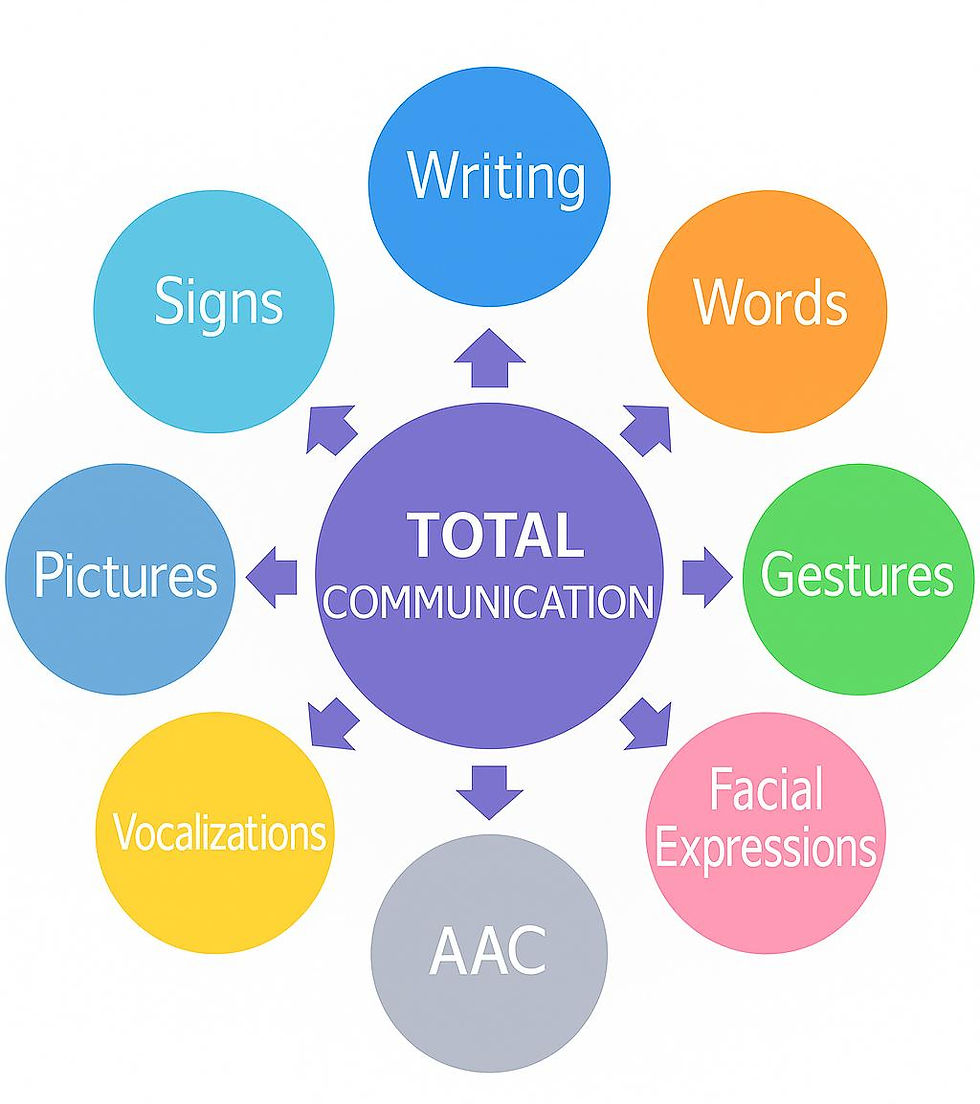
Total Communication encourages the use of spoken words, signs, gestures, pictures, and Augmentative and Alternative Communication (AAC) together, so children can share their ideas and be understood, no matter how their communication develops.
What Is AAC?
Augmentative and Alternative Communication (AAC) is a system for people with limited speech to communicate. AAC gives individuals a way to express wants, needs, thoughts, and feelings long before, or alongside, spoken language.
Low-Tech AAC:
Printed core boards, picture books, or laminated visuals that can be pointed to during routines, play, or therapy sessions.


High-Tech AAC
Speech-generating devices and tablet-based apps that allow children to select and speak words through technology.


Why Use AAC?

AAC gives children a way to communicate before, during, and while speech is developing, which may help reduce frustration, supports language development, and builds confidence.
What the Research Shows:
Studies show that the use of AAC enhances vocabulary growth, sentence length, and social communication.
AAC use has been linked to increased spoken output and reduced behavioral frustration in both minimally verbal and verbally emerging children.
Early introduction of AAC, even in toddlers, supports natural language development by giving children consistent access to language and interaction opportunities.
Aided Language Modeling

Aided Language Modeling (ALM), also called Aided Language Stimulation or Aided Language Input, is one of the most effective ways to teach children how to use their AAC system.
It simply means that when you talk to your child, you also point to or select the same words or symbols on their AAC system, whether that’s a printed board or a high tech speech generating device.
Tips for Using Aided Language Modeling
Aided Language Modeling is most powerful when it becomes part of your daily routines, not something that only happens during “therapy time.” The goal is for your child to see and hear language modeled in real, meaningful contexts throughout the day.
Make low-tech boards accessible.
Laminate and make duplicates so you can keep one in each key location. Keep printed core boards in places where you naturally interact with your child , such as on the fridge, near favorite toys, by the highchair, or in the car.
Core Word of the Week
Pick one or two core words that fit easily into your daily routines, like GO during play or MORE during snack time, and model them often.
This doesn’t mean limiting access to the rest of the core board. Keep the full board visible and available. The goal is to highlight a few key words each week while keeping communication open and flexible.
Model frequently and naturally.
The more your child sees and hears words modeled, the better they understand how language works. Don’t worry about “perfect timing” or “using it right.” What matters most is that your child watches you communicate using their AAC system during real, shared moments.
Model Words in the Here and Now
Use your voice, gestures, and facial expressions to show what a word means in the moment.
For example, say and point to HELP while opening a snack bag, model SAD or MAD when your child is crying, or point to FUNNY or HAPPY while laughing together.
Create Meaningful and Engaging Activities
Turn everyday routines and playtime into natural opportunities to model core words through engaging activities.
See How to Bring AAC into Play and Daily Routines

Make AAC Accessible
Keep all AAC systems visible, and ready to use throughout the day.
The more children see AAC being used, the more likely they are to use it themselves.
Don’t Require Imitation.
It’s okay if your child doesn’t copy you right away. The purpose of modeling is to give your child rich, consistent input. Think of it like language exposure - we don’t expect babies to say “milk” the first time they hear it. They need many experiences of hearing the word paired with the real thing before they try to say it themselves. AAC works the same way.
Respond to All Communication Attempts.
When your child points, gestures, vocalizes, or initiates a bid for joint attention like walks up to show you something, respond as if it’s a meaningful communication. Then model the word for what they’re trying to say. If your child looks at the snack shelf, you might model WANT or EAT. If they hand you a toy, you can model PLAY or HELP.
Celebrate Progress - Even Small Steps.
Every time your child looks at a symbol, points to one, or reacts when you model, they’re learning. Celebrate these moments! Keep the experience positive, playful, and pressure-free. The more your child feels understood and successful, the more they’ll want to communicate.
Be Patient and Don’t Give up Too Soon.
Learning to communicate through AAC takes time, just like learning to talk. It’s common for progress to feel slow at first, but that doesn’t mean the child “isn’t ready” or that the AAC system isn’t working.
Think of AAC the same way you’d think about speech development. Babies hear thousands of words for over a year before they ever say one. AAC users need that same kind of consistent exposure.
Common Myths About AAC

Even though AAC has been around for decades, there are still many misunderstandings about who it’s for and when to use it. These myths can delay a child’s access to communication support.
The following myths are adapted from Romski and Sevcik’s (2005) seminal article on AAC.
Myth 1: AAC is a "last resort".
Many families worry that trying AAC too early might take away from that goal, but research shows the opposite.
AAC can be introduced at any stage to give children a way to express themselves before frustration builds. Early access gives them a voice now, while also supporting future speech and language growth.
Myth 2: AAC will stop my child from talking.
This is one of the most common fears families have. The great news is that research shows the opposite. AAC does not prevent speech. It helps it grow.
As frustration decreases and confidence builds, many children start using AAC and spoken words together, finding their voice in more than one way.
Myth 3: Children must have certain prerequisite skills before using AAC.
There are no specific “readiness” skills needed. In fact, AAC helps children develop these abilities by giving them a way to explore, connect, and be understood.
One of the most exciting things I’ve seen firsthand in my clinical work is how many children make their first real communication breakthroughs once they have access to a system that lets them show what they already know. It is a joy to witness and see.
Myth 4: AAC is only for children with strong cognitive skills.
In the past, high-tech AAC systems were reserved for children with “intact cognition.” Today, the field of AAC has evolved. Research has shown that children with a wide range of learning and communication profiles can benefit from AAC.
There are no specific “readiness skills” a child must have before AAC can be introduced. AAC is simply a tool that supports communication.
Myth 5: A child has to be a certain age to benefit from AAC.
AAC can help children of all ages, including toddlers. There’s no need to wait until a child reaches a certain age or milestone to begin using AAC. In fact, introducing AAC early helps prevent frustration and promotes natural language growth.
Myth 6: Children must learn AAC in a fixed order.
Research shows that symbol learning doesn’t always follow a straight path. Children can understand meaning across many types of symbols, like a photo, drawing, icon, or even a written word, when those symbols are modeled and used meaningfully.
AAC is flexible, and children often use, with great competence, a mix of symbol types and systems (i.e., low-tech and high-tech) as they grow and communicate in new ways.
Just as every child learns differently, AAC should also be customized to fit each child’s needs, interests, and abilities. A “fixed” system with limited symbols can make communication feel restrictive.
Why It Matters
When we honor all the ways children communicate, through words, gestures, signs, pictures, or AAC, we empower them to express who they are. That is the power of communication in all its forms.
Additional Resources
References
Drager, K. D. R., Light, J. C., Speltz, J., Fallon, K. A., & Jeffries, L. Z. (2006). The performance of typically developing 2½-year-olds on dynamic display AAC technologies with different system layouts and language organizations. Journal of Speech, Language, and Hearing Research, 46(2), 298–312. https://doi.org/10.1044/1092-4388(2003/024)
Hart, B., & Risley, T. R. (1995). Meaningful differences in the everyday experience of young American children. Paul H. Brookes Publishing.
Korsten, J. (2011, July). Every Move Counts, Clicks and Chats: A program for developing symbolic communication skills in individuals with severe multiple disabilities.
Millar, D. C., Light, J., & Schlosser, R. W. (2006). The impact of augmentative and alternative communication intervention on the speech production of individuals with developmental disabilities: A research review. Journal of Speech, Language, and Hearing Research, 49(2), 248–264.
https://doi.org/10.1044/1092-4388(2006/021)
Romski, M. A., & Sevcik, R. A. (2005). Augmentative communication and early intervention: Myths and realities. Infants & Young Children, 18(3), 174–185.
https://doi.org/10.1097/00001163-200507000-00002
