
Understanding Your Child's Meltdown or Tantrum

Updated: Aug 3
By Tamara Gonzalez-Scheulov, M.S., CCC-SLP
A Relationship-Based Approach to Emotional Regulation

As parents and caregivers, we often focus on a child’s behavior — tantrums, yelling, refusal to listen, or meltdowns. But behavior is not simply “good” or “bad.”
Behavior is communication, and understanding what is happening in a child’s brain during moments of stress, dysregulation, or emotional overwhelm can change how we respond.
Meltdown or Tantrum?
Although the terms meltdown and tantrum are often used interchangeably, they are not the same.
A tantrum is generally goal-directed. A child may be trying to get something they want, avoid something they don't want, or communicate frustration. Even during a tantrum, many children are still able to think, respond, and adjust their behavior.
A meltdown, on the other hand, happens when a child becomes overwhelmed by stress, sensory input, big emotions, communication challenges, or other demands.
The Three Brain States below provide a helpful framework for understanding children's behavior during tantrums and meltdowns, and how adults can respond with empathy, connection, and support.
The Three Brain States
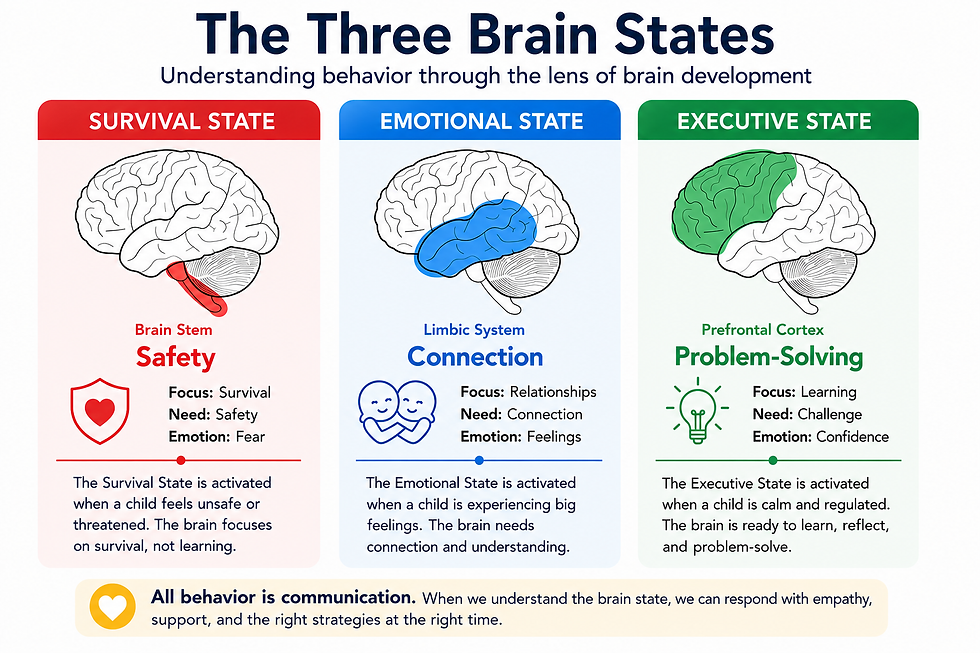
Children move through different brain states throughout the day. These states influence how children think, communicate, behave, and respond to stress, emotions, and relationships.
Understanding these states can help adults respond with more calm, empathy, connection, and effective support during difficult moments.
The Survival State: “Am I Safe?”
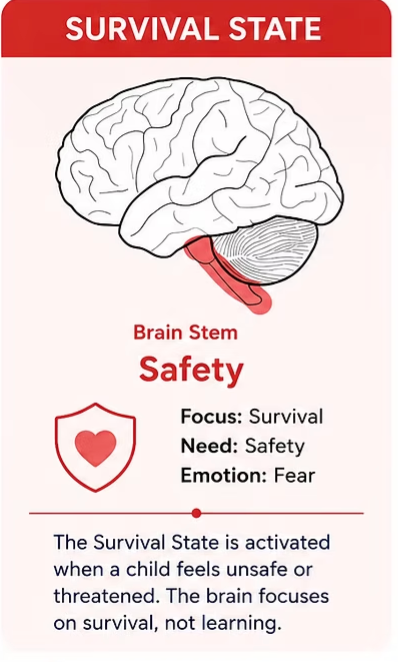
The Survival State is the brain’s most protective and reactive state. This state is often called the fight, flight, or freeze response.
When a child feels threatened, overwhelmed, frightened, overstimulated, dysregulated, or emotionally flooded, the brain shifts into survival mode.
In this state, the nervous system is focused on one thing: feeling safe.
Children in the Survival State may:
Hit, kick, bite, or throw
Run away or hide
Freeze or shut down
Scream or have a meltdown
Refuse directions
Seem irrational or inconsolable
The child is not intentionally choosing to “misbehave” in this moment. Their brain is reacting automatically through a fight, flight, or freeze response.
Tip 1: Focus on Calming the Body First
When children are overwhelmed, calming the body often needs to happen before talking, reasoning, or problem solving.
Simple strategies may include:
taking three slow belly breaths,
tracing a star while breathing slowly,
squeezing a pillow or stuffed animal,
asking for a hug,
jumping, pushing, or other heavy work activities,
or sitting together quietly for a moment.
Young children often need adults to model and practice calming strategies with them many times before they can use them independently.
Helpful prompts may include:
“Let’s take three belly breaths together.”
“Smell the flower… blow out the candle.”
“Trace the star slowly with your finger while you breathe.”
Tip 2: Provide Calm Assertiveness and Structure
Children in the Survival State benefit from calm, confident adults and predictable routines.
Calm assertiveness may sound like:
“I won’t let you hit.”
“My job is to keep you safe. Your job is to help keep it safe.”
“You can be angry and still stay safe.”
“When your body is calm, we can talk.”
“I will help you through this.”
Tip 3: Create a Calm Corner or Safe Space
Some children also benefit from having a calm corner, calm space, or safe space, where they can regroup with adult support during overwhelming moments.
This might include:
soft pillows or bean bags
stuffed animals
feeling charts
breathing visuals
sensory tools
books
headphones,
A calm space is not meant to be punishment. It provides a supportive environment for practicing calming strategies and co-regulation.
Tip 4: Regulate Through Movement
Children often regulate through movement and sensory experiences. Sometimes the fastest way to help a dysregulated child regain balance is to help them move their body.
Movement-based regulation strategies may include:
jumping
climbing
stretching
running outside
animal walks
pushing or pulling activities
For many young children, movement helps the brain shift from overwhelm toward regulation, connection, and readiness for learning.
Why This Matters
When adults respond to survival behaviors with anger, threats, punishment, or shame, the child’s nervous system often becomes even more dysregulated.
Children often need support moving from reactivity to receptivity before they are ready to learn, communicate, or problem solve effectively.
The Emotional State: “Am I Loved?”

Once children begin to feel safe, they may move into the Emotional State. This state is driven by feelings, relationships, connection, and the need to feel understood.
Children in the Emotional State may:
cry easily
become frustrated quickly
argue or whine
seek attention
blame others
or struggle with disappointment
Tip 1: Connect and Redirect
Once a child feels calmer and emotionally supported, adults can begin gently redirecting toward communication, problem solving, and emotional regulation.
Helpful strategies may include:
acknowledging emotions before giving directions,
using fewer words and a calm tone,
describing what to do instead of lecturing,
involving children in problem solving,
and practicing replacement behaviors together.
For example:
“You can say, ‘My turn next.’”
“Let’s ask for help.”
“What could we do instead?”
Children still need calm, predictable boundaries, but empathy and connection help make learning possible.
Tip 2: Build Emotional Awareness
Many children benefit from visual and concrete supports when learning about emotions.
Helpful tools may include:
feeling charts
emotion cards
visual prompts
color-based emotional visuals or systems
or books and stories about emotions.
Children may also need help noticing how emotions feel in their bodies, such as:
tight muscles
fast breathing
clenched fists
tears
butterflies in the stomach
or feeling wiggly or tense
Building emotional awareness helps children gradually recognize emotions, communicate their feelings, and begin developing regulation strategies over time.
Why This Matters
When children feel understood and emotionally supported, they are more likely to develop the skills needed for emotional regulation, communication, problem solving, and healthy relationships.
Over time, children learn that big feelings can be managed safely through connection, support, practice, and guidance.
The Executive State: “I Can Think and Learn”
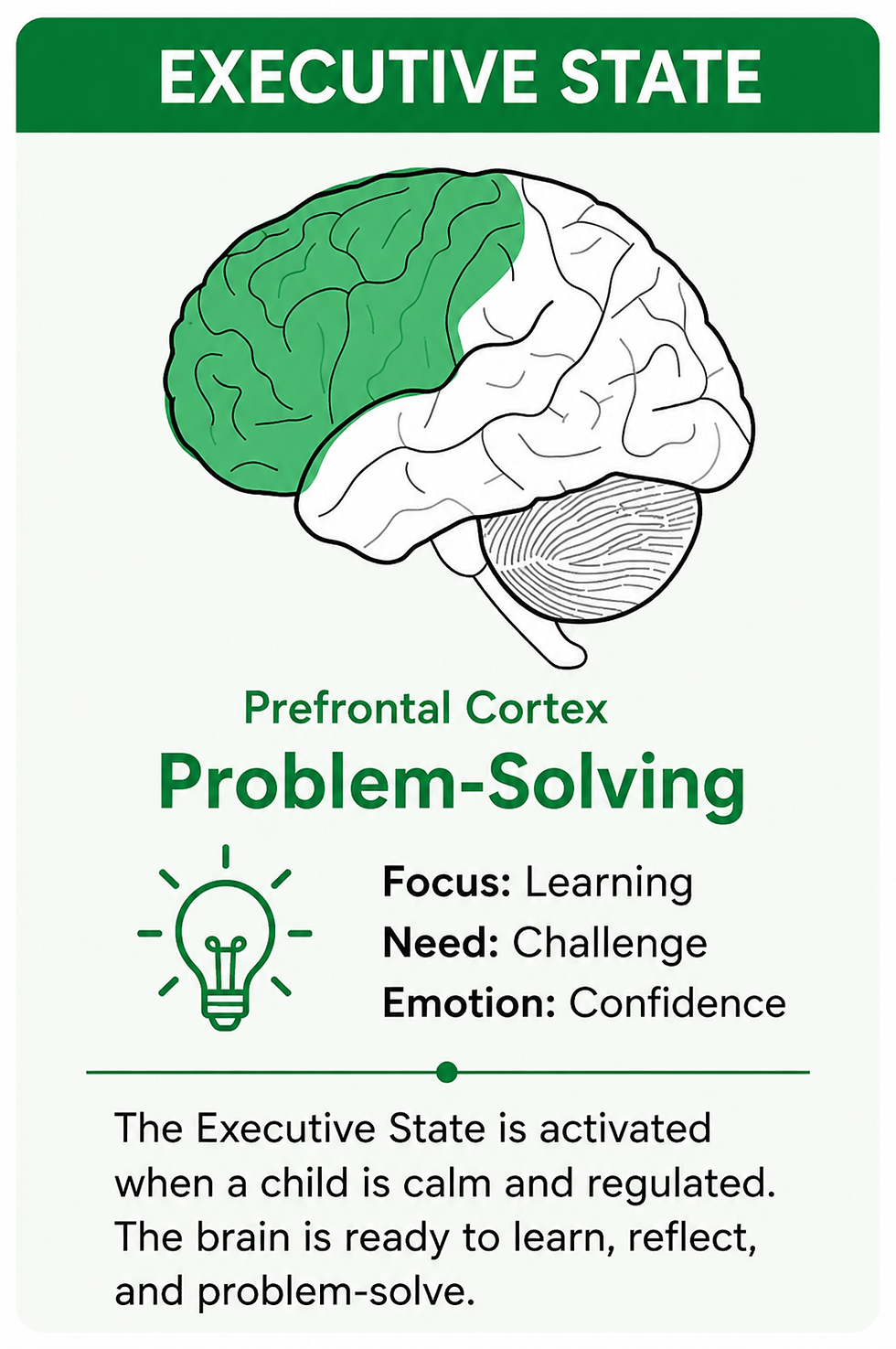
The Executive State is the brain’s optimal learning and problem-solving state. In this state, children are better able to:
problem solve
use language effectively
learn from mistakes
show self-control
listen , reflect, and reason
plan and make choices
and think more flexibly
Tip 1: Problem Solving Together
Children develop executive functioning skills gradually through supportive conversations, modeling, practice, and repetition.
Adults can help children build problem-solving skills by:
involving them in solutions,
practicing replacement behaviors,
encouraging flexible thinking,
and helping children reflect on their choices and emotions.
Helpful questions may include:
“What happened?”
“What can we try next time?”
“How can we solve the problem?”
“What would help your body stay calm?”
Tip 2: Repair
As children grow, they gradually learn that their actions affect other people.
When appropriate, adults can help children practice repairing mistakes in supportive and developmentally appropriate ways.
This may include:
helping clean up
checking on a friend
trying again
offering a kind gesture
or practicing a better solution together
Tip 3: Teach Conflict Resolution
Conflict resolution is a skill that develops gradually through modeling, practice, co-regulation, and supportive relationships. Adults can support conflict resolution by helping children:
take turns
use words to communicate needs
listen to others
brainstorm solutions
practice flexibility
and work through problems together
Helpful prompts may include:
“What happened?”
“How do you feel?"
“What could we try next?”
“How can we solve this together?”
Why This Matters
Executive functioning skills develop gradually through repeated supportive experiences with caring adults. Over time, children build the skills needed for emotional regulation, flexible thinking, communication, self-control, problem solving, and healthy relationships.
Every Child Is Different

Children do not all experience emotions, stress, sensory input, communication, or
regulation in the same way. Some children may have additional differences that impact regulation and behavior, including:
language delays
sensory differences
ADHD
autism spectrum disorder (ASD)
anxiety
developmental delays
trauma
or other neuro-developmental differences.
What looks like defiance or “bad behavior” may sometimes reflect overwhelm, communication difficulties, sensory needs, fatigue, anxiety, trauma, stress, or an underdeveloped regulation system rather than intentional misbehavior.
Understanding these individual differences can help adults respond with more empathy, flexibility, and appropriate support.
The Adult Brain Matters Too
Adults also move through these brain states. When adults feel overwhelmed or stressed, they may also shift into reactive states and respond through yelling, threatening, or power struggles.
Children borrow calm from the adults around them. A regulated adult nervous system helps support a child’s developing ability to regulate their own emotions.
This does not mean parents need to be perfect. It means awareness matters. Sometimes the first step is not calming the child — it is calming ourselves.
Tip 1: KeepYour Cool
Helpful strategies for adults may include:
taking three slow deep breaths,
lowering your voice,
slowing your speech,
pausing before responding,
or repeating calming phrases such as:
“I’m safe.”
“Keep breathing.”
“I can handle this.”
Children learn emotional regulation not only through what adults say, but through what adults model consistently over time.
Tip 2: Don’t Take It Personally
A child’s behavior during stressful moments is often a reflection of overwhelm, underdeveloped regulation skills, communication difficulties, fatigue, sensory needs, or big emotions, not a reflection of your worth as a parent or caregiver.
Tip 3: Repair When We Lose Our Cool
No parent or caregiver stays calm all the time. As parents, caregivers, and professionals, many of us have all experienced moments where stress, overwhelm, or frustration take over.
What matters most is not perfection — it is the ability to reconnect and repair after difficult moments.
Repair may include:
apologizing,
talking about what happened,
naming emotions,
reconnecting through play or affection,
or discussing what everyone could do differently next time.
For example:
“I yelled earlier and I’m sorry”
“I was feeling overwhelmed too”
“Let’s try again together”
“Let’s have a re-do”
“We both had a hard moment”
Repair helps children learn that relationships can recover, mistakes can be repaired, emotions are manageable, and connection can return after conflict.
Children do not need perfect adults. They need safe, responsive adults who are willing to keep learning, reconnecting, and growing alongside them.
Final Thoughts
Understanding the brain-behavior connection can completely change the way we interpret children’s behavior. What looks like defiance may actually be dysregulation. What appears to be “not listening” may be a nervous system stuck in survival mode. Behind every meltdown is a child who needs support before they are ready to learn.
Rather than focusing solely on compliance or perfect behavior, we can focus on building connection, safety, emotional regulation, resilience, and trust over time.
Children thrive when they feel safe, understood, and supported by caring adults who are willing to grow and reconnect alongside them.
Further Reading
The Whole-Brain Child by Daniel J. Siegel and Tina Payne Bryson
Conscious Discipline® by Dr. Becky Bailey
No-Drama Discipline by Daniel Siegel and Tina Payne Bryson
Parenting with Love and Logic by Foster W. Cline and Jim Fay
About the Author

Tamara is the owner of Little Chatterbox, LLC and an SLP with experience across early Intervention, private practice, and school-based settings.
Tamara specializes in supporting infants, toddlers, preschoolers, and early elementary-aged children with speech, language, social communication, and school readiness skills. Her approach combines evidence-based practice with play, connection, and family-centered coaching.
References
Bailey, B. A. (2011). Managing emotional mayhem: The five steps for self-regulation. Loving Guidance.
Bailey, B. A. (2015). Conscious discipline. Loving Guidance.
Delahooke, M. (2019). Beyond behaviors: Using brain science and compassion to understand and solve children’s behavioral challenges. PESI Publishing & Media.
Fay, J., & Fay, C. (2020). Parenting with love and logic: Teaching children responsibility (Updated ed.). NavPress.
Greene, R. W. (2014). The explosive child (5th ed.). HarperCollins.
Greene, R. W. (2016). Raising human beings: Creating a collaborative partnership with your child. Scribner.
Shanker, S. (2016). Self-reg: How to help your child (and you) break the stress cycle and successfully engage with life. Penguin Books.
Siegel, D. J., & Bryson, T. P. (2011). The whole-brain child: 12 revolutionary strategies to nurture your child’s developing mind. Delacorte Press.
Siegel, D. J., & Bryson, T. P. (2014). No-drama discipline: The whole-brain way to calm the chaos and nurture your child’s developing mind. Bantam Books.

